Because the face displays the signs of aging more than any other body feature, it is not surprising that so many people have sought treatment to reverse these facial changes. Often, such patients do not want to simply look younger; rather, they want their faces to show the vitality and youthful energy that they feel. They are worried that the changes of aging make them appear tired, angry, and anxious, when they actually feel vibrant and energetic. If you share these concerns, then you may be a good candidate for a facelift and/or neck lift.

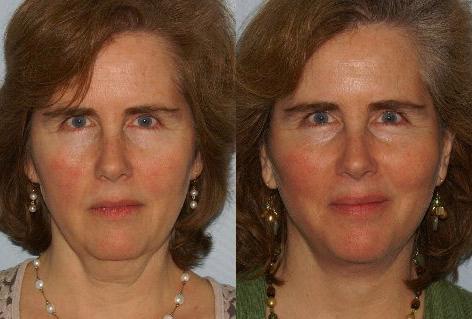
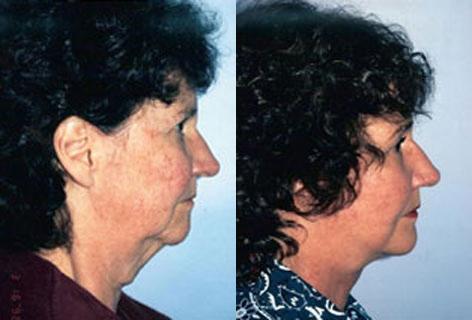
Though many types of facelifts have been described, they all share the same goal – to lift the soft tissues of the face. The medical name for a facelift is “rhytidectomy”, which derives from the Greek terms for wrinkle (ritis) and excision (ektomi). A more important effect of facelifting, however, is the return of facial tissue to its youthful, more elevated position. Patients are thrilled when this occurs – they feel younger and more confident, and are excited to show how they have “turned back the clock” to an earlier age. The following description of facelifts will give you a good introduction to this rewarding procedure, and help you decide if a facelift is right for you.
You should keep in mind that a facelift also improves the appearance of the neck. So, if you are concerned with sagging skin of your neck or bands of tissue extending down from your chin (the “turkey gobbler” appearance), than you may also be interested in how a neck lift can improve the contour of your neck.
Types of Facelifts
The most complete, and arguably the most effective, facelift is the complete , widely undermined , facelift, which involves isolating and elevating both layers of the face – the connective tissue layer and the skin. The recovery from this type of facelift is slightly longer (see below under Recovery) but the results are often the most natural and longest lasting. The face lift rejuvenates the the lower cheeks, the jawline and the neck. Many variations of the facelift technique have been developed, and their names may be familiar to you – examples are the “S-lift”, the “limited incision facelift”,”the weekend facelift”, the “Lifestyle lift”, the “Quicklift” or the “mini-lift”. These techniques also lift the connective tissue and skin, but use less extensive approaches often resulting in quicker healing and less down time. . We prefer to call this limited procedure a “Mini-lift”. It works best on those with with the earlier signs of aging. We counsel you as to which is best for your face and neck.
Facial and Neck Anatomy
Although the skin is the visible layer of the face, and shows all the effects of aging, it is not the only type of facial tissue that is affected by the aging process. Under the skin is a tough, thin, fibrous layer of “connective tissue” that acts as the foundation of the face. So, during a facelift procedure, this tough layer can be elevated and secured in a higher position, and the skin will be gently elevated with it.
A similar anatomic relationship exists in the neck, with the skin being the outer layer. But, the deeper layer is not connective tissue – it is a thin layer of muscle. As with the face, both of these neck layers need to elevated and tightened in order to enhance the neck contour.
Suitable Patients for Facelift
Almost all facelift patients complain of sagging tissues of the face, including skin of the jawline (the “jowls”) and the sides of the cheeks. Patients may also dislike the loose appearance of their neck skin, especially the sagging in the middle of the neck that is most visible from the side. A facelift can correct both of these complaints, leading to a more youthful, rested, and relaxed appearance. If you share these complaints, and want your face to better express your youthful and energetic personality, then you may be an excellent candidate for a facelift.
Ideal patients should also be in good health, and should be able to avoid blood thinning medications around the time of the surgery. Non-smokers have the best chance of excellent results; patients who smoke can still have facelifts, but often a more limited surgery is required.
History of Facelifting
The history of facelifting began relatively recently, around the turn of the last century. The first description of anti-aging surgery was published by Charles Conrad Miller in 1907, in which he recommended cutting some facial muscles through incisions in the mouth and face. Interestingly, one consequence of his facial incisions was the creation of dimples in patients who had none. Fortunately, facelift procedures have evolved a long way since then. Research and experience have led to a very different, and much more effective, technique.
Amazing! Dr. K is a wizard! I plan to get a lot of mileage out of my new face! Many thanks.
The Consultation
When you arrive at our San Francisco practice, you will be asked to complete a detailed questionnaire about your medical and surgical history. Dr. Kabaker will then take standardized photographs, and examine the position and texture of your face and neck skin. Most importantly, you will be given ample time to describe your complaints, and to learn about your proposed procedure and how it might help you. Our doctors will also use a state of the art computer photo alteration program to predict your surgical outcome.
As mentioned elsewhere in this website, we stress patient education. So, during the consultation, you will learn a great deal about the anatomic considerations that cause your complaints, how they will be changed, what you will experience during the recovery, and your risks and alternatives to treatment. You will be given much information in writing, and we are always available for a second consultation, if you wish to review anything.
The Pre-operative Process
For the two weeks prior to your procedure, you should refrain from using common medications that decrease your blood’s ability to clot, including aspirin, ibuprofen, Advil, Motrin, Bufferin, Naprosyn, and large doses of vitamin E. We will give you specific instructions based on your current medications. You should also avoid smoking for two weeks before your surgery. The night before your surgery, you should eat a normal dinner but avoid all oral intake after midnight. This includes drinking anything, even water.
When you schedule your surgery, you will be given a detailed set of instructions that includes much more information. A copy of these instructions is available for you to review now.
Your Procedure
After you are properly anesthetized, incisions will be made that start in the hair of the temples, continue in front of the ears, curve behind the ears, and finish in the hair just behind the ears. Many patients worry that the scars from these incisions will be easily visible – this is not true. They are hidden so well by hair and existing skin creases that only you will know they are there. Your surgeon will then isolate the skin and deep connective tissue of the face, elevate these layers to a more natural and youthful position, and secure them with sutures. A similar approach is used in the neck, and occasionally a patient will need a very short incision under the chin. Again, this incision is so well hidden that the scar will be barely visible.
Anesthesia
Most facelift patients receive deep sedation, which means they are completely asleep during the procedure but are breathing on their own, so there is no need for a breathing tube. This type of anesthesia is always provided by a highly qualified doctor or nurse anesthetist. Every patient will be completely comfortable and the procedure itself will be pain-free.
Facelift Recovery
The discomfort after a facelift is usually very mild, and most patients are quite pleasantly surprised by this. You will be provided pain medication and other suggestions to minimize your soreness. Most patients report a sensation of heaviness tightness in their facial and neck skin, which arises from swelling. Actual pain, though, is fairly rare.
After a facelift, patients have a gauze dressing that is wrapped around your face and neck. This is designed to prevent excessive swelling, and patients occasionally complain about the tightness of the dressing. However, this dressing is extremely important, and sensations of tightness can be controlled. You will need to return to the office the day after surgery, at which point the dressing will be changed to a looser one. The next day, we will again see you in the office to remove the looser dressing, and provide you with further instructions. No more dressings will be needed. The sutures used for your skin incisions will be removed one week after surgery.
You will have mild swelling and bruising of your face and neck for one to two weeks. You should be able to return to light activities after your sutures are removed at one week, but heavy exertion and exercise should be avoided for up to three weeks.
Facelift Test
The face lift test. Do this in the mirror and see if the improvement is significant to you Examples of the face lift test. This shows what a min-lift facelift might do for a prospective patient. It works on the lower cheeks, jaw line and neck for those with the earlier signs of aging. Those with more advanced changes are best served by a standard full facelift which still corrects only the lower cheeks, jaw line and neck.
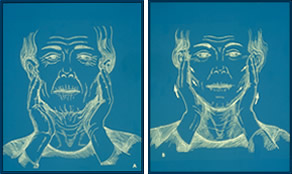
The face lift test. Do this in the mirror and see if the improvement is significant to you.
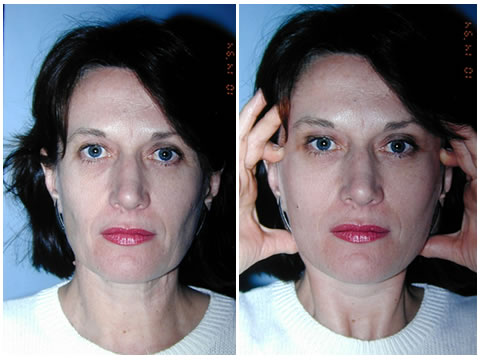
Example of face lift test on live patient
FAQs about Facelift
If you have further questions about facelifts and neck lifts, check the list below to find answers. While some information presented here is also contained in the above text, these short responses should complete your introduction to facelifts and neck lifts. We also encourage you to consult with Dr. Kabaker for individualized answers to all of your questions.
Am I a good candidate for facelifting?
The best facelift patient is in good health, a non-smoker, and is able to avoid blood thinning medications for two weeks before surgery. He or she is unhappy with the sagging skin of the face and neck, which leads to a tired, aged appearance.
How does a facelift differ from a midface lift?
A facelift is really designed to improve the lower 1/3 of the face, and the neck. A midface lift, in contrast, will elevate the soft tissues of the cheeks. These two procedures can be combined in selected patients who have flattened cheeks as well as jowls and neck sagging.
I only want my neck improved. Is this possible without a facelift?
Yes, in some patients the neck can be tightened without a full facelift. This procedure, a “neck lift”, usually involves making just the incision below the chin, and tightening the underlying muscle layer in the middle. Liposuction of the neck may also be used.
My eyes look tired also. What can be done for them?
A facelift does not improve the appearance of the eyes, but this can be easily accomplished with a procedure called a blepharoplasty. This procedure involves removing excess tissue of the eyelids to create a younger and refreshed look. You may also want to consider a brow lift, to raise the eyebrows to a more youthful position.
I also would like to improve the deep crease from my nose to the corner of my mouth. Will a facelift help this?
This crease is called the “nasolabial fold”, and it is usually not improved significantly by a facelift. The nasolabial fold is best treated by injections of fillers under it, or by performing a midface lift which elevates the soft tissue of the cheek.
Can I have other procedures done at the same time as a facelift?
You can, and often patients decide to have their eyes, brows, and/or midface improved at the same time. Doing multiple procedures on the same day does not lengthen the recovery time, and it allows the patient to accomplish many goals with one surgery.
How many doctors should I consult with?
As many as you need to feel completely comfortable with the doctor you choose. Some patients are able to settle on their surgeon after only one consultation, while others require several to best compare their rapport with each doctor.
Am I a good candidate for a mini-facelift?
Only a complete evaluation in our office can help you answer this question. In general, mini-facelifts (or limited incision facelifts) give a limited improvement compared to full facelifts, and this improvement may not last as long. However, mini-facelifts entail shorter recovery times, are less expensive, and still lead to an impressive aesthetic improvement.
Are “before and after” pictures helpful?
They are, and our doctors will show you many. However, the best prediction for the outcome will be determined during your consultation, as your doctor examines your face carefully.
Do you use computers to change my pre-operative photos?
Yes, we do, and we use the latest software available to provide realistic projections. Keep in mind that these “morphed” images are not guarantees of an actual result, but will help you as you plan your procedure.
Do I need to see my own doctor before a facelift?
All patients require basic lab tests, and typically patients over the age of 45 require a written clearance from their personal physicians. All specific requirements are described in the attached Facelift Instructions.
What do I need to do the day before surgery?
The day before a facelift, you should eat normally but avoid excessively heavy meals, or foods that can lead to acid reflux. Prepare your affairs so that you completely relax and rest after surgery. Most importantly, do not eat or drink anything after midnight before your procedure. See the attached Facelift Instructions for all suggestions.
Where does the surgery take place?
Procedures are done at the Aesthetic Facial Plastic Surgery Our Clinic, our fully accredited surgery center.
What kind of anesthetic will be used?
For almost all cases, a deep sedation will be used, which means you will be completely asleep and pain-free during the entire case. No breathing tube will be needed in these cases. Some other patients, having shorter procedures, can have lighter sedation. However, everyone will be completely comfortable during the procedure.
Can I wake up in the middle of surgery?
No. If you are having a deep sedation, an anesthetic professional (anesthesiologist or nurse anesthetist) will be dedicated to providing anesthesia during the entire case.
How long does the procedure take?
Facelifts take about four hours to complete.
How much pain will I have after surgery?
Facelifts do not generate excessive pain during recovery. You will mainly experience a sensation of tightness in your skin, which comes from swelling. Discomfort is well controlled with medications, which we will prescribe.
What are the risks of surgery?
Adverse events are rare. One possible but uncommon risk is bleeding, which occurs under the skin. Usually this bleeding will stop using compression, and no surgical intervention will be required. Very rarely, a patient will need a blood clot removed and bleeding controlled during a very quick surgical procedure. In all cases, the bleeding is not life-threatening. Nerve damage is also reported after facelifts, and may involve sensory or motor nerves. In the former case, numbness of the face will be experienced for several months, but this will recover. If a motor nerve is stretched, there may be slight weakness of certain facial muscles. During your consultation with Dr. Kabaker, you will be able to discuss all risks and complications.
Will I have scars?
The scars of a facelift are well hidden, and are usually only noticeable by the patient.
How much time off should I take from work and exercising?
You should plan to take one to two weeks off of work, so swelling and bruising can resolve. Exercise should be avoided for about three weeks after surgery.
Do patients ever need another facelift?
Your face will always look younger and more refreshed after surgery, but it will continue to age. After a complete facelift, some patients may want a revision surgery, usually ten or more years later.