Hairline Lowering/Forehead Reduction
As many as 20% of all women have what can be described as a high hairline. It usually is a hereditary and natural characteristic. Most modern hairstylists are trained to recognize this and will style the hair combed forward in bangs and thereby disguise it. A high hairline is considered a masculine trait. A hairline that measures its mid-point between 5 cm and 6 cm above a line drawn across the brows is what most classify as a typical and desirable female hairline. A mature male hairline usually is 6-8 cm above the brows.

It has been noted that a high proportion of women with high hairlines have are descendants of peoples of Great Britain or China. Although I have not reviewed any published statistics on this, it has been my clinical observation for the past 30 years. Of course, high hairlines are seen in women from a wide variety of backgrounds. A notable group of women who have high hairlines are African Americans who have a combination of hereditary factors and traumatic factors from straightening the hair and pulling it back, therefore, at times pulling out the weaker hairs in the front and the temples. Usually there is a history of straightening the hair and pulling it tightly back in various hairstyles, i.e., corn rows, tight braids or buns, One should note that in almost every predominantly African American neighborhood, there are a disproportionate number of women’s wig stores which cater to older African American women who want to have the appearance of a full head of hair.
The high inherited hairlines that we often seen from those women of Anglo Saxon ancestry can be exemplified by the history and paintings of Queen Elizabeth I, the great Tudor queen, the daughter of Henry VIII, who reigned for 45 years. She had a naturally high hairline, which is revealed in many portraits. Also, one can find many portraits of women of English nobility of her time who emulated the queen by actually shaving back an inch or so of their hair to more resemble the queen. This was especially true of the women who were in her court. It should be noted that Bette Davis, in portraying Queen Elizabeth, had to shave her hairline back for such a movie role. She played Queen Elizabeth twice once when she was a younger actress, and as an older actress playing the older queen, the hairline had to be kept proportionate, though Ms. Davis’ hairline had receded naturally with age.
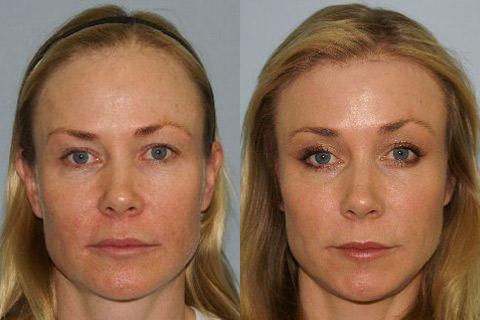
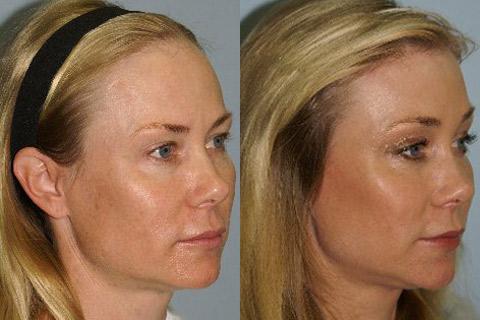
Before and 6 weeks after hairline lowering procedure with browlift
Most women who have high hairlines have a compensatory hairstyle or have little concern with it. Those who have suffered teasing in their formative or teenage years regarding a “big forehead”, “looks like a light bulb”, or looking more like a boy, carry this burden into early adulthood. I find this similar to people who suffered severe acne in their teen years and become psychologically traumatized. Even small acne scars throughout adult life often can obsess them.
In addition to the common hairstyles to disguise the high Tudor-like female hairline, surgery can be performed. A simple, but sophisticated one-stage hairline lowering (forehead reduction) operation can usually bring down the hairline approximately one inch. An appropriate candidate for this operation who desires lowering of a high hairline has to have an appropriate amount of scalp laxity. Alternatively, modern follicular unit hair grafts can be done to achieve a similar effect. The graft operation often has to be repeated to attain the desired density and a 12-18 month period is necessary for growth to be long enough to be incorporated into all but the shortest of female hair styles.
For those who need great advancement of the hairline or who have a very tight scalp, a two-stage procedure wherein balloon-like expander devices are inserted under the scalp in the first stage. The scalp is stretched over a six to eight-week period by gradually inflating the balloon. This allows us to bring the stretched scalp downward as much as we need. In some cases, it has been lowered up to 10 cm.
Although the concept of this hairline advancement surgery is not revolutionary, the sophistication of it is really a modern development.
I love my new hairline and I couldn’t be happier. I have no complaints. I am not feeling very much pain at all. I go about my daily activities and I don’t have any problems. Sincerely,
FAQs about Hairline Lowering
Does your hair thin following hairline lowering operation?
There is a lot of discussion as to what changes occur in the hair after the scalp is stretched and the hairline is lowered. Lowering the hairline, as we do in forehead reduction, stretches the scalp and the hairs actually have to thin out to an imperceptible degree. The same thinning occurs in hair transplantation. We do not give anybody more hair. We take care from one place and put into another. With the hairline lowering operation, however, the change is very subtle and is distributed throughout the scalp rather than having the thinning just in the back. And, the resulting hair density in the front of the scalp is much greater than with hair transplants.
There appears to be many concerns about this especially when the discussion of “shock loss” enters the picture. As an aside, shock loss occurs with almost any scalp surgery, especially with follicular unit hair transplantation. By standard definition, however, “shock loss” means that there will be recovery of hair growth starting in three months and being completed by 9 to 12 months to where hair is again long enough to be incorporated into hair styling. Significant shock loss occurs in less than 2% of patients having hair transplants or hairline lowering.
To lessen this effect of thinning, a number of maneuvers can be done. I have, routinely, for the last 12 years inserted a small dissolvable device, called an Endotine, which anchors the scalp onto the skull within 3 cm of the hairline. This has the effect of taking tension off the closure and, as our recent study has shown, it compresses the hair in the front rather than stretches it. This probably accounts for an infinitesimal more stretching of the scalp behind, but it is spread over the scalp behind for about 25 cm to 30 more centimeters. We have scientifically proven that the use of the Endotine compresses the hair in the front and eliminates frontal thinning that would occur from the scalp being stretched in the front 3 cm of the hairline.
How is it you are determined to be the expert in this operation?
In addition to performing this operation and similar operations for almost 40 years, I, to the best of my knowledge, am the only one who has contributed to the medical literature on this particular procedure for a high hairline or, as some see it, a tall forehead. My publications have been in recognized in peer-reviewed medical journals, in textbooks and Wikipedia.
Will my hair be thinner after the operation?
All hair restoration surgeries will microscopically thin the scalp hair. The hairline lowering operation is no exception; however, the thinning is distributed throughout the top and back of the scalp, so it is imperceptible. I will be conducting scientific studies to actually measure this. Our initial impressions have been that the whole scalp is stretched about 10- 20% and therefore, the density goes down between 10% and 20% on the top and back. Therefore, if you have 100 follicular units/cm2 (as many women do), the hair density would become about 85 follicular units/cm2 after a 3cm hairline advancement. This difference would be imperceptible to the naked eye. Other hair restoration procedures such as follicular unit grafting by FUT, strip harvesting or FUE thin the hair similarly, but the recipient area rarely cannot get that degree of density unless multiple procedures are used.
Is there long-term itching (pruritus) following a Hairline Lowering Surgery?
Most patients experience some temporary itching as sensation returns to the frontal scalp. Personally over my 25 years of experience, I have never had a patient report that he/she developed long-term itching following a hairline lowering surgery.
You are considered by many to the world’s most experienced and senior hairline lowering surgeon. Since you are retiring, where can I find someone like yourself to do my surgery?
since 1986 I have been a co-director of a Facial Plastic Surgery fellowship. A number of my past fellows have considerable knowledge and experience with my personal approach and technique to this surgery. Amongst them is Dr.Jason Dudas of San Francisco who is a plastic surgeon in The Pacific Plastic Surgery Group that is acquiring my practice. Dr Dudas has worked with me on over 100 hairline lowering cases going back to 2012. Although retired from full time practice I will, on a limited basis, be available to assist and consult with Dr. Dudas for those patients who might want my personal input with their care.
How is it you are determined to be the expert in this operation?
In addition to performing this operation and similar operations for almost 40 years, I, to the best of my knowledge, am the only one who has contributed to the medical literature on this particular procedure for a high hairline or, as some see it, a tall forehead. My publications have been in recognized in peer-reviewed medical journals, in textbooks and Wikipedia.
Will my hair be thinner after the operation?
All hair restoration surgeries will microscopically thin the scalp hair. The hairline lowering operation is no exception; however, the thinning is distributed throughout the top and back of the scalp, so it is imperceptible. I will be conducting scientific studies to actually measure this. Our initial impressions have been that the whole scalp is stretched about 10- 20% and therefore, the density goes down between 10% and 20% on the top and back. Therefore, if you have 100 follicular units/cm2 (as many women do), the hair density would become about 85 follicular units/cm2 after a 3cm hairline advancement. This difference would be imperceptible to the naked eye. Other hair restoration procedures such as follicular unit grafting by FUT, strip harvesting or FUE thin the hair similarly, but the recipient area rarely cannot get that degree of density unless multiple procedures are used.
Is there a difference between the hairline lowering operation and a forehead reduction?
In my practice, it is the same procedure. I believe the preference for one name or the other has to do with the perception of the problem by the patient. This can be seen either as a hairline problem or concern for a large or tall forehead.
Can I see more pictures of results on the Internet?
If you are interested in seeing more of these cases, I suggest you come to my office for an in person hairline advancement consultation and I can show you early and late results of patients without having to have the possibility of them being seen and identified throughout the world. To really appreciate what the operation does, it would be best to see the whole face rather than a view from the forehead up or a patient with his/her eyes blanked out. I feel it is very important to protect patient confidentiality. Few people would want to have their identifiable features be shown indiscriminately on the Internet, and I greatly respect that. I am always grateful to those patients who give me consent to use their images. I have over 120 hairline lowering cases in a PowerPoint presentation on my office computer of patients whom I have operated on and who have given me consent to show their pictures to prospective patients within the privacy and confidential setting of my office
What is the cost of Hairline Lowering?
The total cost will be dependent on several factors such as the patient’s goals, the time frame of procedure, external fees, etc. Please contact us (415-379-9015) to learn more about our pricing structure and to schedule a consultation.
Is it possible to make my forehead slimmer and more proportionate with the rest of my facial shape?
If you have the proper elasticity of your scalp and forehead, no hair loss, and no prior surgery, hairline lowering would be a very low-risk procedure. If you, in addition to wanting a lower hairline, want a narrower forehead, hair transplant grafts can be taken from the posterior temple areas during the hairline lowering operation. These grafts can be placed in front of the temple hair, thereby narrowing the forehead. I have done up to 750 grafts in the same hairline lowering session thereby not only lowering the hairline, but narrowing the forehead.
I am concerned about scars. Are there alternative methods of achieving similar results?
The best alternative method is hair grafting utilizing large numbers of follicular unit grafts. This is a technique that I do routinely on men with male-pattern baldness and occasionally on females who want the alternative operation. I see a great economic and time advantage to the hairline lowering procedure with the only drawback I have found to be related to a temporary numbness of the front part of the hair-bearing scalp. As far as scars go, if one were to harvest a strip of donor material for follicular unit grafting, one would have a scar hidden within the hair which should be no more of a problem than the scar at the hairline with hair growing through it. If we did have an unfavorable scar: 1) I would not charge to revise it; 2) I could do follicular unit grafts. Sometimes we do plan on doing grafts if the hair at the temples (the acutely downward directed growing hairs) needs to be brought forward. If so, customary fees for follicular unit grafts would apply.
Do you do this procedure on men?
I do this operation on highly selected men without male pattern baldness or who have had reconstructed hairlines. Men having this operation have to understand the progressive nature of hair loss in males and that further procedures may be required to maintain a result.
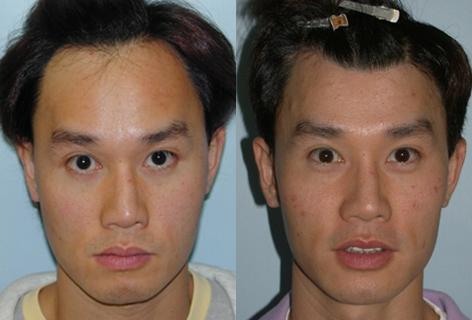
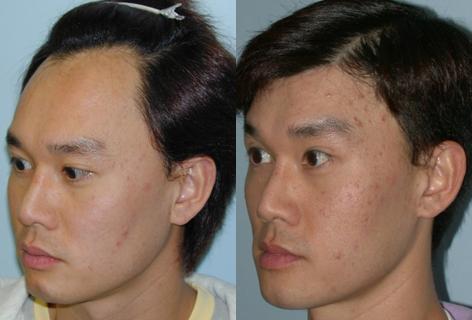
Hairline lowering on a male patient.
What are the side effects and potential complications of this operation?
First of all, all patients experience numbness of the front of the scalp. The sensation almost always returns in a 3-12 month period. Sometimes there is an itching sensation during the recovery period. These set of symptoms can occur after dense graft packing or any incision made in the scalp such as in facelifts and forehead /brow lifts. Second, there can be some shedding of the fine hairs in the front of the scalp within 2-4 weeks after surgery. This is called an “effluvium” and has occurred in about 2% of my surgeries. The hair has always come back after 3 months, in my experience. I sometimes suggest the use of 5% Minoxidil to the front of the hair bearing scalp after surgery. This can lessen the possible fallout and promote a more rapid growth of hairs that might have been shed and those that will be growing through the incision. Similarly, with routine hair transplants, the grafted hairs almost always fall out and go through a three month “resting phase” before appearing again. Like with hair transplants, small, temporary pimples can develop along the suture line as the hairs grow out.
What kind of anesthesia is used for this operation?
We do this operation under intravenous sedation so there is no recollection of any pain. Post operatively, most patients are amazed on how comfortable the whole process was compared to any prior operations. This operation could readily be performed under local anesthesia alone, similar to a hair transplant, but I prefer my patients be totally comfortable.
As with any surgery there can be unfavorable reactions to local anesthetics, sedatives or pain medicine. The possibility of infection (I have had none so far with this procedure.) has to be stated. When expansion is involved we have to consider the possibilities of expander failure or displacement requiring removal and replacement.
When can I appear in public after this operation?
Most of my patients who are having the hairline lowering without a brow lift (the majority) can appear presentable within two days after the surgery. Stitches are in place along the hairline so it has to be covered by hairstyling or some apparel. Most patients are used to wearing bangs which they can again comb over the front hairline. A rare patient has bruising of the forehead and eye areas which usually can be covered by makeup early.
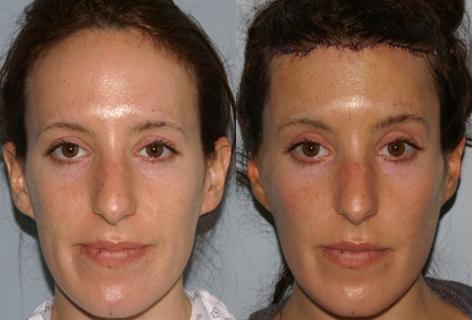
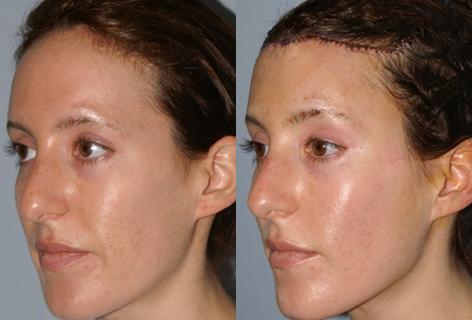
Results just one day after procedure.
When can I wear my hair combed back and not attract attention?
Usually within three to six months, hair grows through and in front of the scar creating a natural, undetectable looking result.
When can I travel?
Most of my patients are from out of town and often from out of the country. They can travel home the afternoon of the day after their surgery. We usually operate on Monday and Wednesdays. I prefer to see my out of area patients on Tuesdays before a reserved surgery time on Wednesday, the next day. We can have an in depth consultation to supplement any verify prior online exchange. If all is in order, we do the procedure the next day, Wednesday. I see the patient the next day, (Thursday morning) and they can travel as soon as that afternoon. I recommend they consider staying another day, but most elect to travel the day after surgery. We can usually arrange for a local colleague to remove sutures 5-8 days after the operation.
Will I need hair transplants (follicular unit grafts) in addition to the hairline lowering?
This all depends on your situation. The hairline lowering does not work well to advance the acutely downward growing hair in the temples. For those patients who want or need these areas augmented, we can do a session of hair transplants at the same sitting as the hairline lowering. We take the donor hair for follicular unit grafts adjacent to the hairline lowering incision that extends into the posterior temple hair. Therefore, we create no additional scars. We have done up to 600 grafts with a hairline lowering procedure. I do not advocate placing grafts at, in, or in front of the hairline suture line at the time of the hairline lowering operation.
On those rare cases where a scar is unfavorable or where a strong cowlick exists, I will tell the patients that future grafts might be needed to totally disguise a scar. This arises in about 10% of cases with less than 2% having grafts.
I have a high hairline and it seems I am losing hair in the front. Will this operation work for me?
I might recommend having hair transplants (grafts) first or instead of the hairline lowering. Or, if a hairline lowering is done, there should be a commitment to having grafts later. The decision depends a lot on the physical findings and expectations of the patient.
What is the farthest you have lowered a hairline with a one-stage operation?
In one case with a very flexible scalp in a patient who had Ehlers-Danlos Syndrome, I was able to move a hairline 5.5 cm.in a one stage operation.
How far can you safely lower a hairline?
This depends on how loose the scalp is, how many galeotomies we do, and how tight we make the closure. These are all judgments that come with experience. I have experience with scalp flap surgery, scalp reduction surgery, and hairline advancement surgery going back to 1975 and can state that my judgment has developed over all these years to where I am not having problems meeting the goals I determine for the individual patient. The hairline lowering operation is a very routine operation in my present practice and has minimal complications.
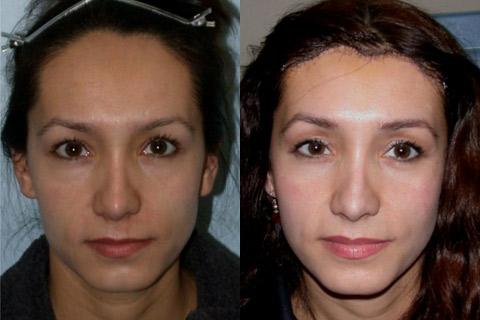
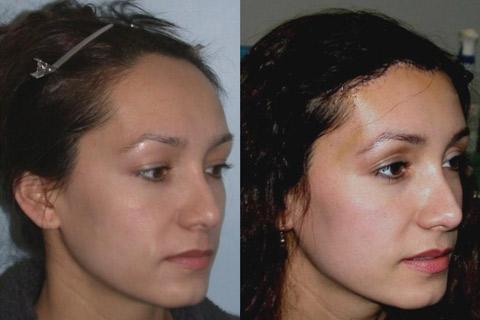
Patient with a high (7.5 cm) hairline.
What problems have been reported with this operation?
As this hairline lowering/forehead reduction operation is gaining popularity through Internet exposure, more surgeons are doing this operation. In my opinion there is learning curve during which complications are more likely to occur. In the past year, I have had communications with surgeons who have had complications which include significant shock loss of hair, visible scars in front of the temples and one case of necrosis (death of the skin). In analyzing these cases, the faults in technique became apparent. These faults have to do with the incisions; design, the method, and extent of the galeotomies, the tension on the wound closure, and the type of fixation of the stretched scalp to the skull. Although I have operated on patients who have had prior facelift and/or browlift surgery, I have had cases of reported shock loss and scalp hair thinning after hair growth returned. These problems have only been on patients with prior scalp surgery. Those patients who have had prior scalp surgery or are actively losing hair should consider this operation carefully.
Can there be bad scars from this operation?
I mentioned that when there is a very strong cowlick part of the scar in the front hairline where the hair grows backwards can be visible. I can tell when this will happen and plan to do a small hair transplant session after six months if the scar is a problem. In many cases, this fine light scar is of no concern to the patient.These scars are almost never “bad”. However, they may not be “invisible”
The same could not be said when the design of the incision goes in front of the temple hair with the attempt to move not only the frontal hair but the temporal hair forward. These scars are parallel to the growth of the hair rather than right angles and can almost never be unnoticeable and very difficult to disguise with hair transplants at a later date. In some cases we can do transplants to the temples in the same session as the hairline lowering.
What other complications have you had or seen?
I have seen two cases done by other physicians who had wide scars within the temple where the incision goes down to the top of the ear. If the operation is being done strictly to lower the hairline (or shorten the forehead), I found there is no need to make a long vertical incision to the top of the ear. This vertical incision can widen as I have seen and could contribute to diminished blood supply to the hair growing of scalp resulting in shock loss of hair which would take one to two years for a long female hair to grow back. This longer incision may be needed when bony contouring of the forehead is done.
I was just wondering, how old do you have to be to receive the hairline lowering surgery, and what would the price range be? Also, if I am an out of town patient would I have to make two different trips, one for the consultation and one for the actual surgery? Please get back to me. Thanks.
I have operated on patients as young as 16. If you are over 18, I can give you instructions that might allow me to assess your suitability for the operation. If you are under 18, I would have to have parental or guardian consent to do so.
The vast majority of my patients come from out of the area or out of the country. By exchange of photographs, videos and Skype calls, I can almost always predict the suitability of a prospective patient which results in just one trip to see me and have the operation. Scalp laxity is one of the most important factors we need to evaluate for hairline lowering or forehead reduction.
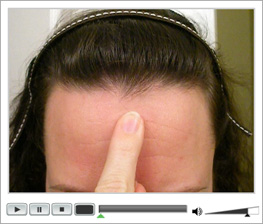
Click here to see examples of scalp laxity
Can I have hair transplant grafts along with my hairline lowering/ forehead reduction operation?
I will only do grafts at the same time as a hairline lowering if they are needed in front of the temple hair. This can contribute to narrowing of the forehead. A maximum of about 600 can be done with this concept. The grafts are taken adjacent to the hairline advancement incision ends which are in the temporal areas. No additional scars are thus created.
I am opposed to harvesting grafts from the back of the head in the same operation for 2 reasons. The first one being that an incision in the back of the scalp along with the one in the front could cut off critical blood supply to the scalp (a terrible complication I once have reviewed). The second is that I am concerned as where to put a large number of grafts. I would expect poor survival and compromise to the circulation to the front of the hairline scar if they are densely packed in the front. I have no problem with doing traditional follicular unit transplant grafts 7-9 months after the hairline lowering has healed in order to get further lowering, to reshape the front hairline or to hide a visible scar then the hair is very thin. To do the 600 grafts along with the hairline lowering would add about $ 3000 to the hairline lowering charges.
What is a cost comparison with the graft method of lowering a hairline?
If one were to lower the hairline, our usual 2.0 cm to 2.5 cm, we would move approximately 4000 to 6000 hairs or 2000 to 3000 follicular units.
Based upon that movement, the cost is about one dollar a hair compared to grafting which in our practice would be more than twice that cost done over two or three sessions. Also, as I mentioned, with the time factor involved, the result is apparent and disguisable and cosmetically effective within two to seven days, even with sutures in place.
Do you know a surgeon in another part of the world who does this procedure?
I have spent many years performing this procedure and refining the technique. I have lectured to colleagues on this hairline lowering operation and have published scientific articles and textbook chapters about my experiences. Other surgeons should be privy to this information but I cannot vouch for their actual hands on training and experience other than my Fellows. And, although the concept is straightforward, there are many fine details such as the angles of the incisions, the differences in the direction of hair growth in hairlines, the flexibility of the scalp, preservation of certain arterial supply, and other judgment factors that make it hard for me in good faith to recommend others who have any significant experience with my present technique. The basic concept should be familiar to most cosmetic plastic surgeons that do open (pretrichial or trichophytic) forehead lifts, but the subtleties of the hairline lowering are known and experienced by few. From what I see on the Internet and the questions I get in calls from other surgeons, I feel that no one will do the procedure exactly as I do it.
I know many hair transplant surgeons who could do a good job using follicular unit grafts to lower a hairline.
If I cannot see you in person for an actual consultation, what can be done?
FOR OUT OF TOWN PATIENTS: I will ask for a detailed description of your condition, photos and videos and other details by e-mail interaction and eventually have a telephone consultation. If we can determine that you are a good candidate for this procedure, we can schedule surgery on a day after a scheduled consultation. If the consultation is satisfactory for all, we can go ahead with the surgery. Patients can leave for home as early as the day after surgery. I usually can find a local colleague to perform suture removal. Therefore, one would need to stay only a minimum of two nights in the area.
For those coming from another country, I often suggest planning a vacation in the San Francisco, California area as most patients are very comfortable and presentable in a few days after surgery.
Part of my my hairline has hair growing in a backward direction which has been described as a cowlick. What problems does this possibly represent for hairline lowering surgery?
When the hair grows backwards, it is often difficult to get a completely hidden scar result. The trichophytic incision does not work as well as with forward growing hair. I often make efforts to further trim the top of the skin at the cowlick side to encourage hair growth through the scar. For those patients to end up having a thin noticeable scar just before the hair is seen, a small hair transplant session can readily correct this.
I am an African-American woman who has lost hair in the front from straightening processes. I’ve used chemicals and braids. I’ve been told I have traction alopecia. Can I get a result with a hairline lowering if the rest of my scalp has good hair?
So much depends on the quality and location of the hair you have and the flexibility of the scalp. Also it is important that after any hair surgery with your type of problem, that no wigs, braids, extensions , hair addition or headband be worn for any period of time for the first six months after the procedure. The best thing to do is to have your hair styled in one of the many forward direction styles such as bangs or curls. This way the healing areas will be hidden by your hairstyle and there will be no pressure or traction on the hairs themselves.
This section will provide you with additional valuable information about the hairline lowering procedure. If you have any further questions about this or any procedure feel free to contact the office (415) 379-9015 and our staff will be glad to assist you.